Sean R. Roberts on China’s War on the Uyghurs
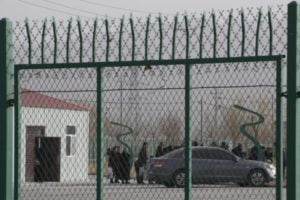
The Chinese Communist Party is “essentially waging a war against a portion of its own population (the Uyghur people), not as an ‘enemy,’ but as a ‘threat’ to society at large.”
If one asks Beijing why more than a million Uyghurs have been forced into “re-education” camps in Xinjiang, the answer would likely call attention to the alleged “terrorist” threat posed by Uyghurs and the need to purge the community of extremism. As Sean R. Roberts, an associate professor of the practice of international affairs and director of the International Development Studies Program at George Washington University’s Elliott School of International Affairs, explores in his new book, China’s leaders have seized upon the language of the Global War on Terror to frame their policies in Xinjiang.
But “The War on the Uyghurs: China’s Internal Campaign against a Muslim Minority” goes deeper, examining the history of settler colonialism in Xinjiang, the shaping of a “terrorism” narrative around the Uyghurs, and the devastating consequences, which amount to nothing short of cultural genocide. In an interview with The Diplomat’s Catherine Putz, Roberts explains the “war” on Uyghurs, how China has packaged and implement its policies, and what it would take for the global community to change China’s calculus on its Xinjiang policy.
Your book is titled “The War on the Uyghurs: China’s Internal Campaign against a Muslim Minority.” When did this “war” start, who are the opposing sides, and what’s its root cause?
First, this is not a war in the traditional sense with two opposing sides. The title of the book is a play on words evocative of the “war on terror,” itself a very non-traditional one-sided “war” which has helped facilitate the fate of the Uyghurs in China. However, one could say that what is happening to Uyghurs inside China today is akin to Michel Foucault’s articulation of a modern “biopolitical” war, where the state (the Chinese Communist Party) is essentially waging a war against a portion of its own population (the Uyghur people), not as an “enemy,” but as a “threat” to society at large. That war between the Chinese state and Uyghurs most visibly began in 2017 when the state began arbitrarily and extrajudicially interning large swaths of the Uyghur population under the pretense of combatting alleged “terrorism” and “extremism.”
While this mass internment appeared to happen suddenly, one of the arguments of my book is that it was the outcome of tension that had been building for some time between the state and the Uyghur people over the question of self-determination in a region that Uyghurs consider their homeland. This tension has long existed to different degrees between Uyghurs and modern Chinese states since at least the late 19th century when the region first became a province of the Qing Dynasty, but it has been particularly pronounced and has escalated since the 1990s when the PRC began earnestly trying to integrate the Uyghurs and their homeland more solidly into a consolidating and more powerful Chinese polity. These attempts at “integration” since the 1990s have involved progressively violent suppression of any indications of Uyghur disloyalty to the state, but it was only in 2017 that these efforts began targeting all Uyghurs as embodying a threat to the PRC, or at least to its colonial aims in the Uyghur homeland.
What is happening to the Uyghurs, therefore, has little to do with an alleged “terrorist threat” and is much more like other historical examples of indigenous people being decimated, marginalized, and displaced by a settler colonial power when they resist complete capitulation and assimilation. In this sense, the “war on the Uyghurs” is not really a war in the traditional sense, but a process of conquest, occupation, and ultimately displacement and ethnically profiled marginalization.
Source: The Diplomat

Campaign for Uyghurs
Campaign for Uyghurs
We defend the human rights of Uyghur people and the free world by exposing and confronting the Chinese government's genocide, and empowering Uyghur women and youth in the diaspora.