American Exceptionalism and Its Application in Holding Authoritarian China Accountable
 The image of America as a “city on a hill” is not a new one . While the origin of that phrase is in itself troubling for the mere fact of its naïveté concerning human nature, we ought to be reminded as citizens of the United States, and in fact, global citizens, of the reality that certain sins are not equal. The truth of the U.S.’s existence as a city on a hill lies in the reality of comparative paradise. In the same way that wealth is not equal but one may be comparatively rich, we must also recognize that while every country has failings as regards treating human beings with the dignity that they deserve, some countries are in fact relatively blessed in comparison.
We should not be interested in defending America’s sins or even the original concept of American exceptionalism. But we should be interested in relaying what failing to acknowledge that some systems are better for the flourishing of discussion on human rights may lead to.
We cannot ignore the atrocious stain upon the United States as a nation due to slavery and its resultant injustices that continue to manifest today. As Ken Wytsma said in “The Myth of Equality”, “Like Dinesh D’Souza there is nowhere I’d rather live. But even if we have turned off the spigot of state-sponsored racism (which arguably we haven’t), it doesn’t mean the water has fully run out of the hose.” The realities of past sins are that they continue to haunt for generations. However, the very introspection of willingness of citizens of the United States to come out in full force and with boldness denounce oppression is indeed exceptional. The voices most critical of the United States, are, in fact, often found in the United States, and this is indeed exceptional, particularly when compared with the realities of life under governments with more authoritarian characteristics.
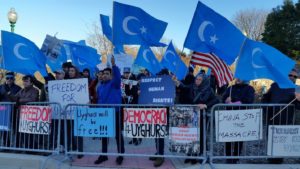
Perhaps indeed some of the United States willingness to criticize comes from having made these same mistakes. A Chinese government official in East Turkistan, referred to by the Chinese government as Xinjiang Uyghur Autonomous Region, recently said the idea of their human rights abuses was to “sacrifice a generation” to provide stability for the next. We know by history that it doesn’t work that way. The wounds caused by the abuses will affect people permanently until there is proactive work to heal rather than justification of the actions.
The United States is not a “worse” abuser, they are a more visible one. While many countries hide their crimes and oppress those who speak out, all things are brought to light in the United States, dissected, and railed against. To say anything else is ignorant of reality.
David Kaye’s recent article, “American the Unexceptional” is one of many representations of a commonly held viewpoint:that the United States, far from being a “city on a hill” possesses a ruined reputation and too many human rights violations itself to be able to address human rights violations committed by other countries. This is foolishness. The phrase “city on a hill” came from the reference of being a community others look up to. It was originally used by John Winthrop in reference to the Massachusetts Bay colony that he believed would become an eternal example of Puritan utopia, in short, perfection. This has obviously never been the case for the United States, and likely never will be.
It also must be noted that in addition to the violations attached to racism, we also find another type of sin: that of complicity in other nations’ human rights violations. Much criticism of the United States “intruding” in others affairs is based on the mistaken notion that it is in fact, intrusion. Addressing the United States complicity in human rights abuses is an issue of U.S. policy. While such policies may affect other countries, these effects are in fact valid consequences as the United States involvement is rightfully questioned.
To ignore the reality that the United States does in fact possess a preferable system that allows for positive changes to occur, and for citizens to use their voices to make changes, is insulting to those who struggle and face persecution in their respective countries. To not only ignore that fact but to also put forth a concurrent falsity that most of the countries the U.S. is involved in trying to influence in the areas of human rights are at the same level is ignorant of reality and harmful to the cause of global justice.
The truth of American exceptionalism as a concept of hope is that it is not based on the idea that Americans are better, more moral people than anyone else, rather, American exceptionalism might be better described as the exceptional system that allows the potential of men to commit evil to be confronted and checked, while man’s capacity to do good is allowed to flourish.
As human rights activists from other countries such as Russia, China, and other major violators of human rights and democratic freedoms have agreed, the West provides a world in which people can acknowledge that leaders and others do wrong. Anyone can speak this truth. Anyone can propose change. When there is a disease outbreak we do not arrest doctors who warn about it. The press can call the President a racist, incompetent, or whatsoever they please. And this, in comparison to alternate authoritarian systems, is truly exceptional.

Campaign for Uyghurs
Campaign for Uyghurs
We defend the human rights of Uyghur people and the free world by exposing and confronting the Chinese government's genocide, and empowering Uyghur women and youth in the diaspora.